

A gentle force pushes the charismatic and they let it.
You know cool when you see it.
Freddie Mercury walking onto the stage at Live Aid, doing his vocal warm-ups with 72,000 people — and somehow becoming more magnetic by revealing he was just a guy warming up. Paul Newman on screen, never pushing for your sympathy, and getting all of it. The Beatles radiating sheer joy rather than the glazed showbiz smiles of professionals.
You feel it in certain people in your life, too. That person who walks into a room and the room shifts — not because they’re performing, but because they’re present. Not because they’re trying to be cool, but because they’ve stopped trying to be anything.
I’ve spent over 30 years working with more than 10,000 professionals across six continents, developing over 500 transformational distinctions. And this question has haunted me the whole time: What is this quality, really? And why can’t most people access it — even when they desperately want to?
I’ll tell you how I first found it.
The Dip That Changed Everything

In 1991, I was an engineer. I had always wanted to dance. But I felt like a klutz — an analytical mind trapped in a body that didn’t know how to move. When I told my mentor about this dream, he got quiet. Thoughtful.
The next day, he called me at work. His voice was gruff. “You need a breakthrough in passion, cool, and risk-taking. Find a ballroom dance studio. Sign up for a dance show and a competition.” Then he hung up on me.
I was paying this man a lot of money per month. So after some recovery from the indignity of being hung up on, I took his coaching. I found Londance Studios and signed up for everything — a show and a competition. One of the competition dances was the tango. My teacher Susan would also be my partner.
I had three months. I practiced. A lot. One day Susan called me over and said, “I’m going to show you how to dip me — but don’t do this during the competition.” I followed her lead and managed a clumsy dip. Didn’t think much about it.
Competition day. Susan pulls me aside backstage. “Easy peasy. Just do the simple beginner moves and we should place third or fourth.”
I get on the floor with Susan. We begin our tango basics. One, two, three, four, turn. I’m going through the routine, present to the music, when something occurred to me.
Why not dip her?
In the same instant, my brain screamed: I have no insurance and Susan will kill me and have me for a snack.
And in the next instant — the one that mattered — I saw the choice. Not a calculated decision. A choice from nothing. A choice for adventure. For risk. For being fully alive in that moment rather than safely executing the plan.
I dipped her.
I still remember the look she gave me. Pure fury. And then — like true professionals — we both flashed brilliant fake smiles for the judges.
There was an eerie silence in the entire ballroom dance hall, and then five hundred people odd got on tables, stood at their chairs and yelled, screamed and clapped for us.
First prize in tango. First prize in waltz. First prize in foxtrot. Never having danced before in my life.
But here’s what happened after the competition that really shook me. Everyone — women, men, gay guys, straight guys, I swear even the pet dogs — started treating me differently. Relating to me differently. Something had shifted, and it wasn’t just a trophy.
I had to take a breath. I stepped outside and sat under a yellow streetlight on the bumper of a Volkswagen. And I said to myself: My life will never be the same again.
I couldn’t go back to rigid — playing it safe, no risks, executing the plan.
I couldn’t go back to chaos — unconscious reaction without choice.
I had arrived somewhere else entirely. Somewhere I didn’t have a name for yet.
It took me years to understand what happened that night. It took Complexity Theory, Flow Psychology, and three decades of my own transformation work to finally language it.
What I arrived at was cool.
Cool Is a Position on a Spectrum

Imagine a spectrum. On one end: rigidity. On the other: chaos. In the narrow, dynamic center: flexibility.
Rigidity looks like over-control, predictability, safety-seeking. The person who plans every minute and collapses when plans change. The organization locked in bureaucratic paralysis. The leader who stifles creativity in the name of “process.” Safe — but dead inside. That was me before the dip: just do the beginner moves, get third or fourth, don’t rock the boat.
Chaos looks like reactivity, impulsiveness, no coherent structure. The person with brilliant ideas who can’t sustain anything. The organization in constant crisis mode. Free — but fragmented. That would have been me if I’d dipped Susan out of recklessness, without the three months of practice, without the presence to choose in the moment.
Cool — real cool — is neither. It’s the living center between them. It’s a prepared body meeting a spontaneous choice. Structure meeting surprise. Discipline meeting adventure.
And this isn’t just philosophy. It’s physics.
The Science Behind Cool
Complexity Theory: Life at the Edge
Stuart Kauffman, one of the founders of Complexity Science at the Santa Fe Institute, made a statement that stopped me cold the first time I read it: “Life exists at the edge of chaos.”
Complexity Theory studies how living systems — ecosystems, economies, neural networks, organizations — adapt and evolve. The finding is universal: systems that are too ordered become rigid and brittle. Systems that are too disordered fragment and dissipate. But systems poised at the edge of chaos — the narrow zone between order and disorder — exhibit something remarkable. They self-organize. They innovate. They learn. They become capable of producing outcomes that no individual component could produce alone.
The edge of chaos is where a vibrant democracy operates. Where a healthy market functions. Where a mature personality lives.
And here’s the insight that connects this to human transformation: systems don’t arrive at the edge by trying to get there. They evolve toward it naturally when feedback loops are healthy and the system isn’t locked into rigid control. In human terms, you don’t achieve cool. You unblock it — by clearing the patterns that keep pushing you toward rigidity or chaos.
Flow Psychology: The Inner Edge

Mihaly Csikszentmihalyi — widely regarded as the father of Positive Psychology and flow research — discovered the same territory from the inside out.
His research, spanning decades and thousands of subjects across every domain of human endeavor, found that people are happiest and most productive not when they’re relaxed, but when they’re fully engaged in activities where challenge matches skill. This is the flow state — where self-consciousness dissolves, time transforms, action and awareness merge, and people report their deepest experiences of meaning, creativity, and joy.
The parallel to Complexity Theory is exact:
- Too little challenge = boredom (rigidity of experience)
- Too much challenge = anxiety (chaos of experience)
- Challenge matched to skill = flow (the edge of chaos)
Csikszentmihalyi called the person who naturally enters flow more easily the autotelic personality — someone who does things for their own sake rather than to achieve external goals. That maps perfectly to what I’ve observed in my transformation work: cool people don’t perform coolness to get results. They are cool, and results follow.
On that dance floor, I wasn’t thinking about winning. I was present to the music, present to the moment, and when the choice appeared — I took it. Three months of practice had matched my skill to the challenge. The rest was flow.
Both sciences point to the same truth: the most alive, productive, creative, and magnetic state a human being can occupy is not safety and not chaos — it is flexibility.
Why You Can’t Find the Center (The Mirror Maze)
If cool is so natural — if living systems evolve toward the edge of chaos — why are most people stuck at one extreme or the other?
In my work, I call this trap the Mirror Maze — a distinction I developed over years of observing thousands of people oscillating between false opposites.
“I’m either disciplined or I’m free.”
“I’m either in control or I’m out of control.”
“I’m either safe or I’m alive.”
The Mirror Maze keeps you bouncing between rigidity and chaos, convinced these are the only two options. You tighten up (rigidity), feel dead inside, swing to chaos (impulsive decisions, blown commitments, reactive living), feel out of control, and swing back to rigidity. Each mirror reflects the other. Neither is the exit.
Cool is the door out of the Mirror Maze. Not a compromise between the extremes. An entirely different relationship to structure, freedom, and being alive.
But what keeps the maze going? What blocks the door?
The Patterns That Kill Cool

Through my proprietary framework called X/Y Technology — developed across 30+ years and hundreds of transformational distinctions — I’ve found that every departure from cool, every swing toward rigidity or chaos, is driven by a specific pattern:
You avoid X (an uncomfortable truth) with a seemingly honorable intention of Y (a justification that makes the avoidance look noble or righteous).
X is what you don’t want to face. Y is the story that makes not facing it seem like a virtue.
Here’s what this looks like:
The Controller avoids chaos and being out of control, with the seemingly honorable intention of safety, certainty, and reliability. The backfire: rigidity that kills aliveness and drives people away — creating the very instability they feared.
The Rebel avoids structure and being “caged,” with the seemingly honorable intention of freedom, spontaneity, and creativity. The backfire: chaos that destroys the very freedom they sought.
The Performer avoids being invisible or ordinary, with the seemingly honorable intention of impact and being seen. The backfire: inauthenticity that creates the distance and irrelevance they feared.
The Withdrawer avoids vulnerability and being hurt, with the seemingly honorable intention of emotional safety. The backfire: isolation that amplifies the pain they were trying to prevent.
The Pleaser avoids conflict and being disliked, with the seemingly honorable intention of harmony and connection. The backfire: resentment that poisons the very relationships they were protecting.
The Expert avoids being seen as incompetent, with the seemingly honorable intention of credibility and respect. The backfire: paralysis from needing to know everything before acting.
Every one of these patterns is a departure from the edge of chaos. The Controller leaves the edge toward rigidity. The Rebel leaves toward chaos. The rest find their own exit from the alive center into a defended position.
And here’s the deepest finding from my ontological inquiry into X/Y Technology: Y cannot exist without the concealment of X. The justification collapses the moment the avoidance is seen. You don’t have to dismantle both. Reveal the truth you’ve been avoiding, and the noble-sounding story that protected it disappears on its own. Like turning on a light — you don’t fight darkness.
On the bumper of that Volkswagen, what I couldn’t yet language was this: my X had been avoiding the risk of looking foolish with a seemingly honorable Y of being responsible and analytical. The dip collapsed the whole structure in one moment.
What Cool Actually Looks Like
Undefended Presence
In my work on charisma — studying icons like Mercury, Newman, Brando, and The Beatles through the lens of transformation — a clear pattern emerged. I call it Undefended Presence: the willingness to be fully seen without armor, without strategy, without holding back reserves.
The charismatic person has resolved what I call the Inauthenticity Trap — the oscillation between performing (trying to look good) and hiding (trying to avoid looking bad). Both drain the energy that would otherwise be available for genuine presence. The cool person has stopped doing both.
Charisma = the visible evidence of someone who is unconflicted about being themselves.
Being a Clearing
This draws on Heidegger’s concept of Lichtung — the clearing in the forest where light enters. In my application of this to transformation and leadership, the cool person isn’t a container holding the right answers. They are the open space where authentic possibilities can emerge.
In a sales conversation, you stop executing a formula and start being the space where genuine value shows up. In leadership, you stop forcing outcomes and start creating conditions where innovation emerges. In relationships, you stop managing and start being with.
A Narrow Authenticity Gap
I distinguish what I call the Authenticity Gap — the distance between the surface truth (the story you tell yourself and others) and the core truth (what’s actually happening underneath). I visualize it as two concentric circles: the outer is your surface truth, the inner is your core truth, and the line between them is your transformational journey.
As Gloria Steinem put it: “The truth will set you free, but first it will piss you off.”
Cool people have a narrow gap. The energy that most people burn maintaining the distance — the performing, the hiding, the self-deception — is freed. That freed energy shows up as presence, creativity, magnetism, and what others experience as “cool.”
Leading from the Future
The rigid person is organized by the past — defensive strategies, what worked before. The chaotic person has no temporal organization — they’re reactive, blown by whatever arrives.
The cool person is pulled forward by a future they have declared into existence. This is the distinction I draw between Causing (authoring your life) and Hoping (spectating on it). When you lead from the future, discipline becomes the container for creativity, not a cage. Structure serves vision. Freedom becomes real — not the fake freedom of refusing all structure, but the authentic freedom of conscious design in service of something that matters.
The Deepest Paradox: Ordinary Being Extraordinary

Here’s what surprises people most about genuine cool: the extraordinary doesn’t get added to ordinary. It emerges from being fully ordinary.
Mercury warming up with 72,000 people. Newman refusing to push. An engineer from an analytical background choosing to dip his dance partner at a beginner’s competition.
In my framework, I call this the Ordinary Human Being, Being Extraordinary — the recognition that superpowers aren’t created in transformation. They’re uncovered. The X/Y avoidance patterns were consuming the energy and capacity that was always there. When the patterns clear, there’s a double gift: freedom from constriction and access to abilities you didn’t know you had.
My clients report this consistently: they don’t just feel lighter. They discover they are more than they thought — not through addition, but through subtraction.
The Practice
Cool is not a destination. It’s a practice — moment by moment.
Notice where you are on the spectrum. Right now: are you rigid, chaotic, or flexible? Don’t judge it. Just see it. The seeing itself begins the shift.
Identify the X/Y. If you’re rigid: what uncomfortable truth are you avoiding? What noble story justifies the over-control? If you’re chaotic: what structure are you running from? What heroic narrative supports the refusal?
Close the Authenticity Gap. What’s the surface truth you’re telling yourself right now? What’s the core truth underneath? What would happen if you simply acknowledged the core truth — to yourself, and to one other person?
Become a clearing. Instead of managing the next conversation or meeting, practice being the space where what needs to emerge can emerge. Drop the agenda. Trust the process.
Lead from the future. What is your stand? Not your to-do list — your stand. Is your life organized around that declared future, or organized around avoiding the past?
Give completely. The cool person holds nothing back. They give from overflow, not scarcity. Practice complete release — not as strategy, but because withholding takes more energy than giving.
A Whisper, Not a Shout
One last distinction — one I call The Whisper. Transformation cannot be sold. It can only be invited. A whisper speaks to the part of you that already knows, without triggering the defenses that would reject the message.
This article is a whisper. It points to the territory. But the territory itself — the lived experience of genuine coolness, of operating at the edge of chaos, of flowing from authentic flexibility — can’t be captured in language. It can only be walked into.
Cool = Undefended Presence + Complete Giving + Full Humanity
Cool = Flexibility at the Edge of Chaos
Cool = Flow as a Way of Being
You were born cool. The work isn’t acquiring it. The work is clearing what blocks it.
I know this because I sat on the bumper of a Volkswagen under a yellow streetlight and felt what it was like to arrive there — not by becoming someone new, but by finally letting the engineer dance.

Sunil Bhaskaran is CEO of Global Communities LLC and has spent 30+ years developing over 500 transformational distinctions — including X/Y Technology, the Mirror Maze, the Authenticity Gap, Undefended Presence, The Whisper, and the frameworks referenced in this article — through work with 10,000+ professionals across six continents. The scientific foundations draw on Stuart Kauffman and the Santa Fe Institute’s work in Complexity Theory, and Mihaly Csikszentmihalyi’s pioneering research in Flow Psychology. Sunil integrates Eastern philosophy (Zen Buddhism), Western existentialism (Heidegger), and lived transformation into practical tools for leaders and entrepreneurs.
This article is part of the Joyful Transformations Distinction Collection.
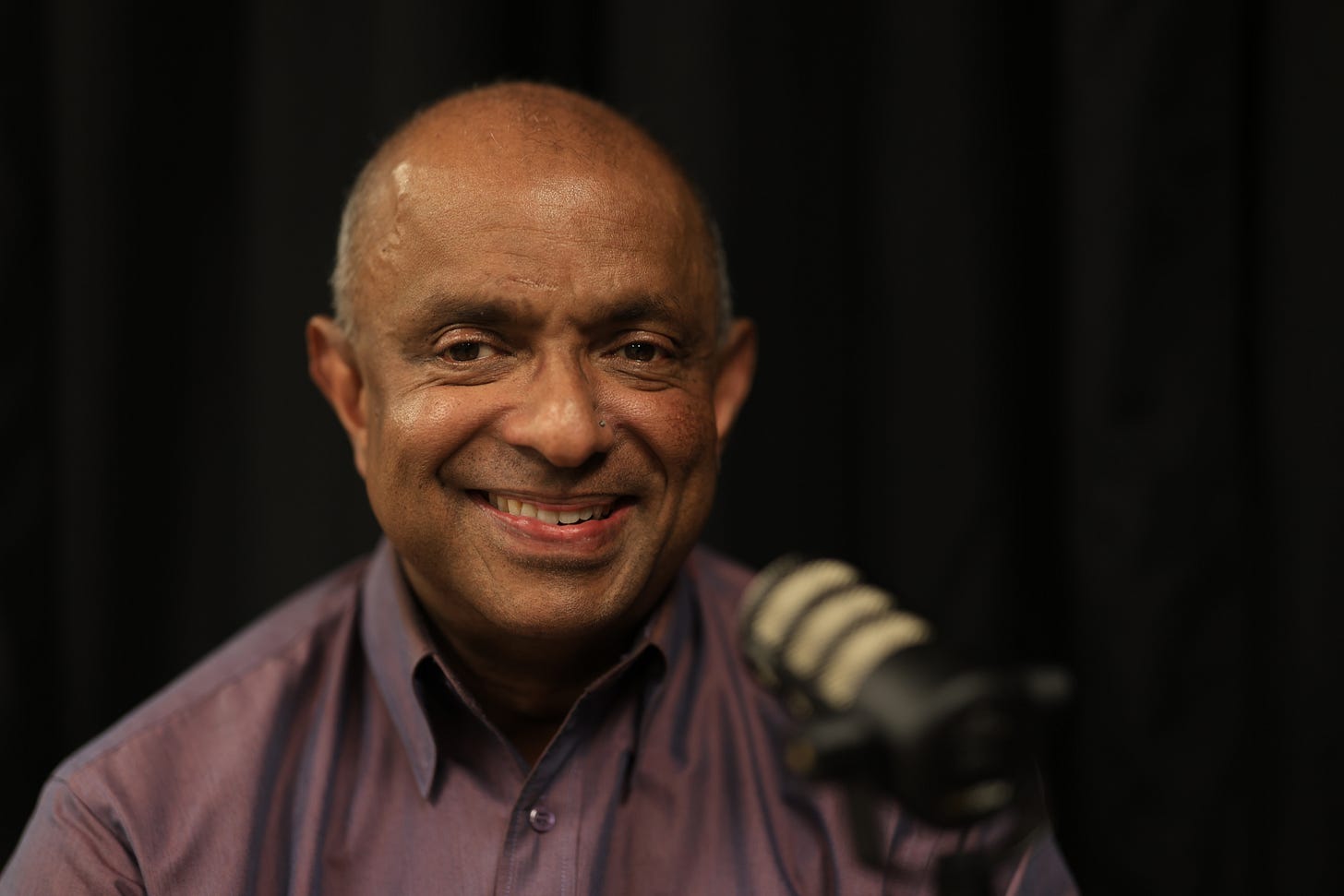

Since 1991, I’ve been reflecting on, designing, and implementing methodologies and systems for bringing a transcendent, creative and innovative approach to critical aspects of entrepreneurship.

